
Dynamic Load Balancing (DLB) in EV Charging: The Complete Guide
Ever experienced a tripped breaker while charging your EV at night? Discover how Dynamic Load Balancing prevents electrical overloads, optimizes solar PV energy, and maximizes multi-charger efficiency.
Static vs. Dynamic Allocation
Solar PV Excess Charging
OCPP Multi-Charger DLM
Table of Contents
2. Static vs. Dynamic Load Balancing
3. DLB for Home Charging
4. DLB for Multiple EV Chargers
5. Charger Support & Wallbox Solutions
6. Why DLB is the Future
7. Frequently Asked Questions
1. What is Load Balancing?
As electric vehicles become mainstream, managing household and commercial electrical loads efficiently is more important than ever. High-power Level 2 EV chargers (drawing 32 A to 48 A) are among the largest electricity consumers in any building.
Load balancing (or load matching) is the process of intelligently distributing available electrical capacity across appliances and charging stations in real time. It prevents grid overloads, ensures safe operations, and eliminates the risk of unexpected circuit breaker trips or equipment failure without requiring expensive electrical service upgrades.
2. Static vs. Dynamic Load Balancing
Static Load Balancing
Fixed Allocation
Assigns a rigid, pre-set maximum power limit to each EV charger regardless of actual building power consumption or appliance state.
Dynamic Load Balancing (DLB)
Intelligent & Adaptive
Continuously tracks total property energy consumption via CT transformers or smart meters, dynamically throttling charging speeds up or down in real time.
| Comparison Feature | Static Load Balancing | Dynamic Load Balancing (DLB) |
|---|---|---|
| Power Allocation | Fixed current limit set during installation | Real-time adaptive current adjustment |
| Grid Capacity Efficiency | Low (Wastes available off-peak capacity) | Maximum (Utilizes 100% of remaining headroom) |
| Circuit Breaker Safety | Requires conservative manual derating | Automated protection against panel overload |
| Panel Upgrade Necessity | Often requires expensive panel upgrade ($1,500+) | Avoids panel upgrades by managing demand |
| Solar PV Matching | Not supported | Supports green surplus solar charging mode |
3. How DLB Works in Home Charging
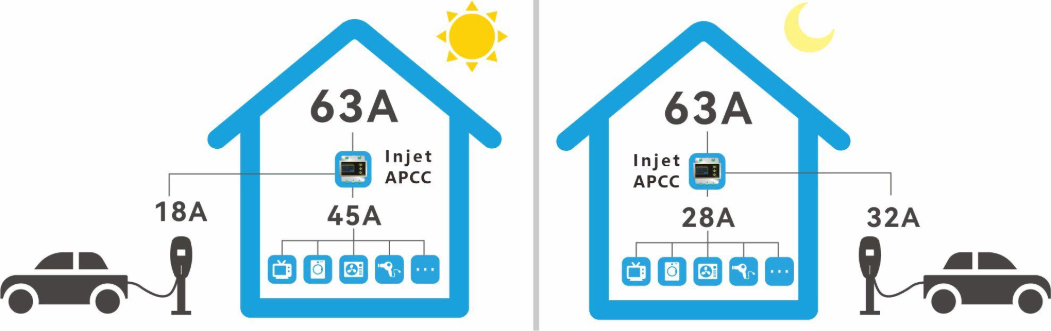
In a residential setup, a Current Transformer (CT) clamp sensor or smart energy meter is installed at the main electrical panel. The CT clamp acts as the “eyes” of the system, measuring total household power draw hundreds of times per second.
When heavy loads (heat pumps, ovens, dryers) switch on, DLB instantly throttles the charger down to maintain panel safety.
As household appliances turn off late at night, DLB ramps charger output back up to maximum speed (e.g., full 7.4 kW or 11 kW).
When integrated with rooftop solar, DLB routes surplus daytime generation directly into the EV battery, minimizing grid feed-in.
4. DLB for Multiple EV Chargers & Commercial Fleets
Balanced Strategy (Equal Sharing)
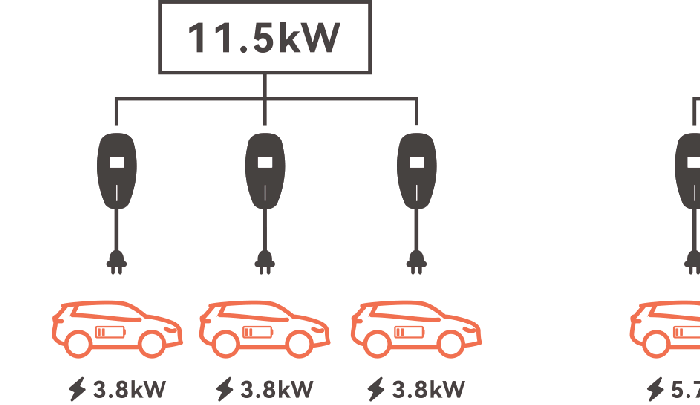
Power is divided equally among all plugged-in vehicles. If 30 kW is available across 3 vehicles, each receives 10 kW. As vehicles finish charging and disconnect, released power is automatically reallocated to active chargers.
Priority Strategy (VIP & Fleet Matching)
Allows site managers to designate priority bays (e.g., delivery vans needing rapid turnaround or VIP tenants). The DLB controller routes maximum available power to priority slots while maintaining baseline trickle power for remaining units.
5. Do All EV Chargers Support Dynamic Load Balancing?
No. Basic or budget entry-level chargers lack the required control microcontrollers, communication interfaces (RS485 Modbus, Ethernet, Wi-Fi), and CT sensor integration modules necessary for DLB.
YDCHARGE Smart Wallbox Solutions
Our professional-grade YDCHARGE Mode 3 AC Wallboxes (7.4 kW / 11 kW / 22 kW) feature built-in hardware DLB support, CT clamp sensors, solar eco-matching modes, and OCPP 1.6J / 2.0.1 smart gateway protocols for residential and fleet management.
6. Why Dynamic Load Balancing is the Future of E-Mobility
AI & Predictive Energy Analytics
Next-generation DLB algorithms anticipate household consumption patterns and weather forecasts, scheduling charging during optimal low-cost, low-demand hours.
Vehicle-to-Grid (V2G) Integration
Bi-directional DLB enables EVs to serve as mobile energy storage, discharging power back to the building during peak grid spikes and charging when clean energy is abundant.
7. Frequently Asked Questions (FAQ)
What happens if I don’t use load balancing?
Can I upgrade my existing EV charger to support DLB?
Is Dynamic Load Balancing only for commercial use?

Do AC EVSE with Double Insulation Require a Protective Earth Connection and an RCD?
EVSE Regulatory Standards & Safety Architecture Is PE & RCD Required for Double-Insulated AC EVSE? An engineering breakdown comparing [...]
Dynamic Load Balancing (DLB): Why It’s Crucial for Your EV Charger
Smart Energy Management & Grid Efficiency Guide Dynamic Load Balancing (DLB) in EV Charging: The Complete Guide Ever experienced [...]

⚡ EV Charging Modes Explained: Which One Powers Your Drive?
EV Charging Infrastructure & Technical Guide Understanding the Four EV Charging Modes: A Complete Guide From basic domestic sockets [...]
⚡ Why Is My 7.4kW AC Charger Only Delivering 6.4kW? Common Causes Explained
EV Charging Engineering & Efficiency Guide Why Your 7.4kW AC Charger Only Delivers 6.4kW (or Less) Answering one of [...]
Why Does My EV Charger Randomly Stop Charging? 5 Common Causes Explained
EV Charging Engineering & Troubleshooting Guide Understanding the Root Causes Behind Random Charging Interruptions Why AC EV charging randomly [...]
How Much Power Can a Mode 2 Portable EV Charger Deliver?
EV Charging Industry & Technical Guide Understanding the Limits and Possibilities of Mode 2 EV Charging How much power [...]
